How to Improve Reaction Time in Sports: Why Reflexes Are Overrated
If you type "How to improve reaction time" into YouTube, you see videos of athletes catching tennis balls or hitting flashing lights on a wall.
These drills look cool. They make you feel fast. But have you ever noticed that the "fastest" players on the field, like Messi or Brady, aren't always the ones with the fastest twitch muscles?
They don't have better Reflexes. They have better Anticipation.
If you want actually to play faster in Soccer, Hockey, or Football, you need to understand the two types of speed.
Want more resources like this guide?
Join the Alta Pursuit Membership and get:
✅ Downloadable worksheets
✅ Athlete performance planners
✅ Elite Coaching Advice
1. Simple Reaction (The "Video Game" Speed)
This is how fast you click a button when you see a light.
The Truth: This is mostly genetic. You can improve it slightly, but you have a "biological ceiling."
The Problem: In a game, you never just "react" to a light. You have to react to a defender, the ball, and your teammates all at once.
2. Complex Reaction (The "Game" Speed)
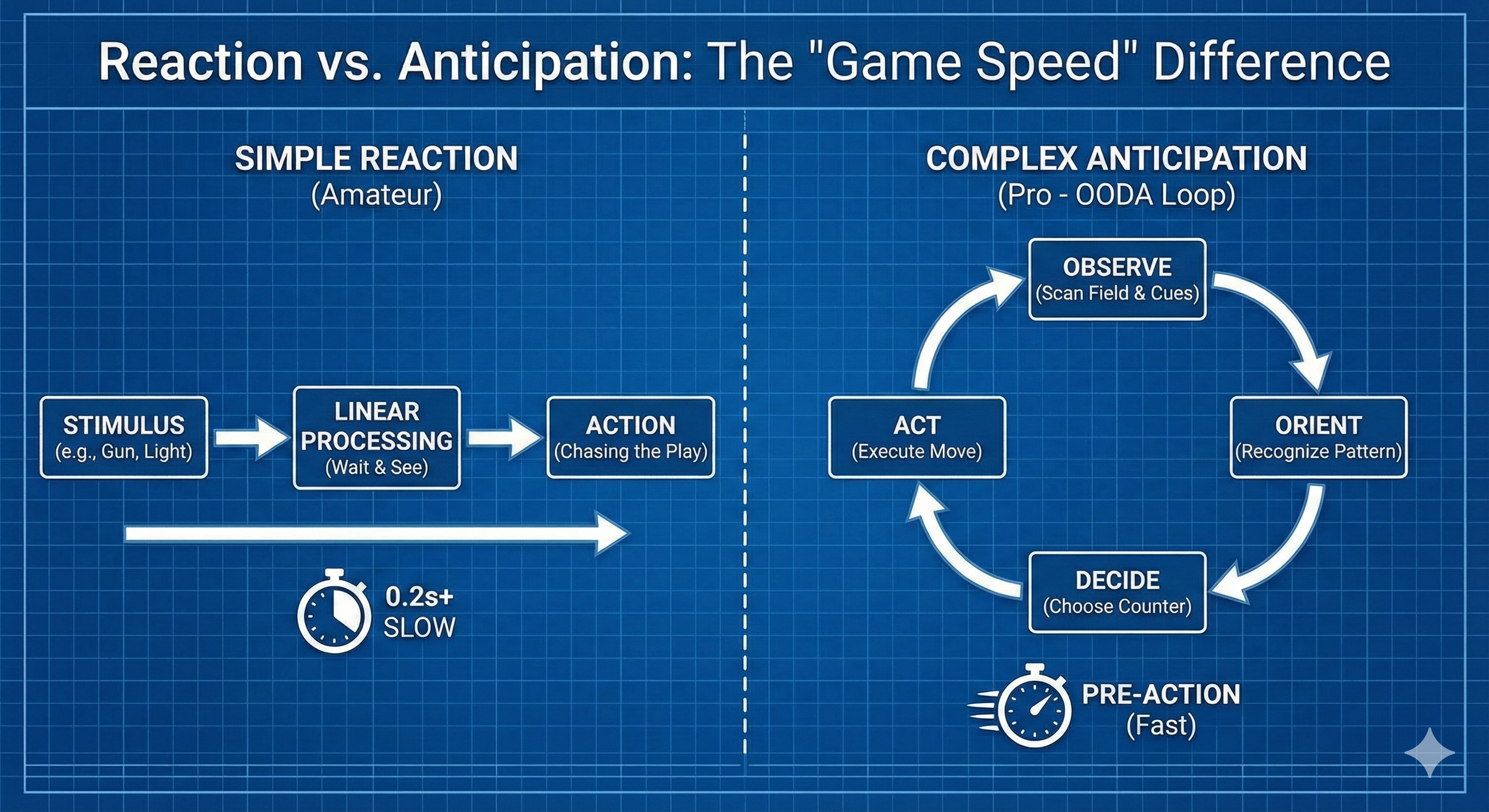
This is how fast you process information. This is what we train at Alta Pursuit.
The Secret: Elite athletes don't wait to see what happens. They predict what happens.
The Science: By the time your eyes see a pass, send the signal to your brain, and your brain tells your legs to move, it takes about 0.2 seconds. That is too slow. You need to move before the pass is kicked.
How to Actually Train for Speed
Stop doing "reaction drills" where you turn your brain off. Start doing "Decision Drills."
A. Scan Before You Receive: Most young athletes stare at the ball. The moment the ball leaves your teammate's foot, you should already know where your next pass is going. This is called a "Pre-Scan."
Drill: When playing FIFA or watching a game on TV, force yourself to look away from the ball every 3 seconds to see where the open space is. Pause the game and review, over and over.
B. Read the Body, Not the Ball: The ball can't tell you where it's going. The opponent's hips can.
The Tip: If a defender’s hips are turned right, they cannot instantly sprint left. That is your cue to attack their weak side. You aren't reacting to their movement; you are reacting to their posture.
C. The "Colour Call" Drill: You can do this at home.
The Setup: Have a partner toss a ball that has different colours on it (or write numbers on a tennis ball).
The Rule: You have to catch the ball, but you must shout the colour/number facing you before your hands touch it.
Why: This forces your brain to process visual data while your body is moving. That is real sports speed.
Reaction vs. Anticipation Guide
| Feature | Raw Reaction (Amateur) | Anticipation (Pro) |
|---|---|---|
| What you watch | The Ball. | The Space & The Opponent. |
| When you move | After the play happens. | Before the play happens. |
| Speed source | Fast Twitch Muscles. | Fast Brain Processing. |
| Result | You are chasing the play. | The ball comes to you. |
If you need help structuring your workout schedule, reach out to our coaches for a consultation.
Join the Alta Pursuit Athlete Community today and transform your potential into elite.
ELITE ATHLETE COACHING
〰️
ELITE ATHLETE COACHING 〰️
Your "Tier One" Athlete Membership is the competitive edge you’ve been looking for. Get immediate access to exclusive tools and resources designed to sharpen your mindset and fast-track your path to Tier One Status in sports and in life. It's time to build the proof.