Football Route Running: Selling the Fake with Your Hips, Not Your Head
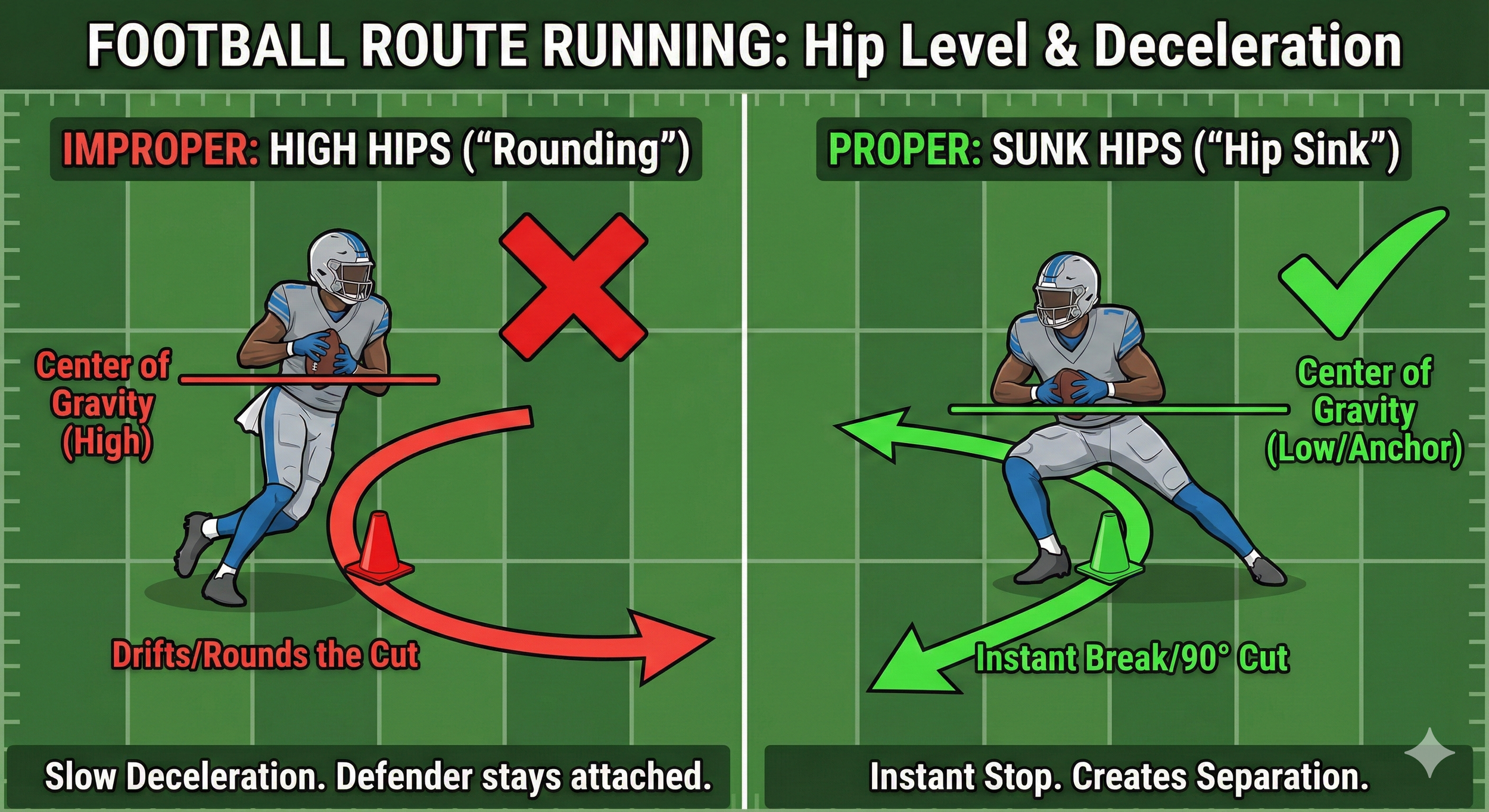
Most young receivers think getting open is about running away from the defender. In reality, separation is created by deceleration. If you are running at 20mph, the defender is also running at 20mph. If you can stop in 2 steps, but the defender takes 4 steps to stop, you have just created 2 yards of separation. That is an open pass.
The Problem: "Rounding" the Route
When young athletes try to turn, they often stay tall. Because their Center of Gravity (belly button) is high, physics dictates they must take a wide, circular path to slow down.
The "Drift": This is called "rounding" the cut. It allows the defender to stay on your hip because you never actually threatened to stop.
The Tell: If you slow down gradually before the break, you are telling the defender exactly when you are going to turn.

Want more resources like this guide?
Join the Alta Pursuit Membership and get:
✅ Downloadable worksheets
✅ Athlete performance planners
✅ Elite Coaching Advice
The Solution: The "Hip Sink" (The Anchor)
To stop your body instantly, you must drop your weight violently. Imagine there is a string connecting your butt to the ground. At the top of the route, you snap that string tight.
Drop the Level: You drop your hips 6-12 inches. This lowers your center of gravity, acting as an anchor.
The Drumroll: Your feet shouldn't take long strides. They should "buzz" or "drumroll" quickly. This keeps your feet under your hips, allowing you to explode out in any direction (90 degrees, 45 degrees, or back to the QB).
| Feature | Average Route Runner (Rounding) | Elite Route Runner (Cutting) |
|---|---|---|
| Approach Speed | Decelerates early (Tells the secret). | Full Speed until the break (Sells the Go). |
| Hip Level | High/Tall (Hard to stop). | Sunk/Low (Instant anchor). |
| Footwork | Long Strides through the turn. | "Drumroll" (Choppy, fast steps). |
| The Fake | Head/Shoulder movement only. | Torso/Level Change (Scares the defender). |
| Separation | Minimal (Defender stays close). | Massive (Defender runs past). |
The Progression: Building the Brakes
You cannot cut fast if your legs aren't strong enough to absorb the force of stopping.
Level 1: The "Snap Down" (Stationary)
Setup: Stand tall with feet hip-width apart.
Action: Throw your hands down and drop your hips into an athletic stance as fast as possible.
Sound: Your feet should hit the ground with a quick "Pap-Pap" sound.
Goal: Go from tall to low faster than gravity would take you.
Level 2: The 10-Yard Stop (Linear)
Setup: Sprint 10 yards.
Action: At the 10-yard line, perform the "Snap Down" and freeze.
Check: Did you drift past the line? Did your chest fall forward? Keep your chest up, hips down.
Level 3: The 90-Degree Break (The Dig)
Setup: Sprint 10 yards.
Action: Snap down, pivot on the outside foot, and explode at a 90-degree angle.
Constraint: Do not look for the ball until you have exited the break. Looking too early raises your chest and slows you down.
Pro Tip: "Sell the Go"
The only way the Hip Sink works is if the defender thinks you are running a "Go" route (sprinting deep). You must keep your shoulders square and arms pumping until the very last millisecond before you drop your weight. If you look like a sprinter, the defender will open their hips to run fast—making them vulnerable to the stop.
Join the Alta Pursuit Athlete Community today and transform your potential into elite.
ELITE ATHLETE COACHING
〰️
ELITE ATHLETE COACHING 〰️
Your "Tier One" Athlete Membership is the competitive edge you’ve been looking for. Get immediate access to exclusive tools and resources designed to sharpen your mindset and fast-track your path to Tier One Status in sports and in life. It's time to build the proof.